Zoning & Floodplain Administrator
Kristen Leahy
802-472-1686
zoning.administrator@hardwickvt.gov
Fall 2026 Office Hours
| Monday – 11 am to 1 pm Tuesday – 8:30 am to 2 pm Wednesday – 9:30 am to 2 pm Thursday – 8:30 am to 2 pm – Closing at 11 on 10/22 Friday – By Appointment Saturday – By Appointment The Zoning Office will be closed from 11/6/26 to 12/6/26 for medical leave. | |
| Outside of daily stated hours, by appointment. |
FLOOD RELATED ZONING REGULATIONS
Understanding Floodplains, Floodways, and River Corridors (2025)
HISTORIC STRUCTURES IN THE FLOODPLAIN
Guidelines on Flood Adaptation for Rehabilitating Historic Buildings – 2021
Guidelines for Reducing Flood Risk to Residential Buildings that cannot be elevated – 2015
AFTER A FLOOD
Prioritize Your Health and Safety – 2024 (Neighbor to Neighbor)
Mental Health Resources for Flood Recovery – 2024 (The Vermont Department of Mental Health)
Guide for Cleaning up Mold After a Flood – 2015 (FEMA)
Four Ways to Reduce Flood Insurance Costs (FEMA)
Flood Resistant Materials for Rebuilding After a Flood – 2024 (State of Vermont)
Repairing Your Flooded Home – 2010 (FEMA)
Protecting Building Utility Systems from Flood Damage – 2017 (FEMA)
Flood Damage Resistant Materials – 2008 (FEMA)
Post Flooding Technical Assistance Toolkit for Agriculture – 2024 (State of Vermont)
FLOOD RELATED PLANNING DOCUMENTS
Understanding Flood Storage and Floodplain Restoration (2025)
Recommended Actions to Improve the Safety of Vermonters During Major Flooding Events – UVM – 2024
Lamoille River Tactical Basin Plan – 2021
Lamoille River Tactical Basin Plan – Story map – please note that this link takes you away from our website to a story map – Lamoille River Tactical Basin Plan Overview
Basin 7 Lamoille Assessment Report -2016
A Strategy to Protect Communities and Ensure Clean Water by Mike Kline – 2016
Notes from the Draft Tactical Basin Plan – 2016
Upper Lamoille River Geomorphic Assessment – 2009
River Recovery in the Wake of Large Floods – 2024 (Jordan Fields at Trout Unlimited) (YouTube Video)
LAMOILLE RIVER and COOPER BROOK HYDRAULIC STUDY – SLR
Funding provided by the Economic Development Administration (through Lamoille County Planning Commission) – EDA grant.
Presentation Slides from SLR – December 3, 2025 at Hardwick
Overview of next steps from the study – 12/18/25 – created for the Select Board
HCTV video of the presentation – recording was inadvertently damaged. No video will follow
BRIDGE 31 – EAST HARDWICK/GREENSBORO BEND
Bridge 31 Community Survey Overview – Created for the Hardwick Select Board – 3-9-26
Bridge 31 – photographs from the impacts prior to demolition in April 2024
Engineering Reviews – To be added – Verdantas
JACKSON DAM
Jackson Dam Memo from SLR – 3-13-26
Power Point Slides from SLR for 3-26-26 meeting
Act 250 Documents for the Ice Breakers
Associated Documents for the 2-27-26 Memo
Hardwick Lake Dam 2019 Visual Inspection
Hardwick Lake Today and Tomorrow by the Northern Rivers Land Trust – 2013
Report on the Jackson Bridge Dam by the Vermont Natural Resources Council – 2001
Hardwick Lake Dam 2024 Visual Inspection
From the Watershed: Five Collected Articles based on the SLR Jackson Dam Memo
ADDITIONAL DAMS IN THE LAMOILLE WATERSHED NEAR HARDWICK
EAP for East Long Pond, Nichols Pond and Mackville Pond – 2012
EAP for Mackville Pond Dam – 2016
Mackville Dam 2022 Visual Inspection
East Long Pond Dam 2022 Visual Inspection
Nichols Dam 2023 Visual Inspection
Ripple Effects – Watershed Forum in 2025 and 2026
Ripple Effects 2025
Ripple Effects is Hardwick’s annual public watershed education series, bringing together scientists, practitioners, and community members to better understand how water moves through our landscape and what that means for flooding, erosion, natural systems, and community resilience.
The 2025 series explored several of the questions that came up repeatedly in Hardwick following the floods of 2023 and 2024, including dredging, beavers and natural infrastructure, dams and river connectivity, and the relationship between droughts, floods, and a changing climate.
Dredging Rivers
September 3, 2025
Roy Schiff of SLR International Corporation and Shayne Jaquith of The Nature Conservancy discussed sediment movement, floodplains, river corridors, and the role and limitations of dredging as a river management strategy.
Resources:
Watch the HCTV recording: HCTV video link
Understanding Flood Storage and Floodplain Restoration
Understanding Floodplains, Floodways, and River Corridors
Dredging Makes Floods More Dangerous
Beavers and Natural Infrastructure
September 10, 2025
Tyler Brown of Vermont Fish and Wildlife, Meg Carter of the NorthWoods Stewardship Center, and Erin Rodgers of Trout Unlimited discussed the role beavers can play in watershed health and natural infrastructure, along with practical approaches for managing conflicts between beavers and people.
Resources:
Watch the HCTV recording: HCTV video link
Beavers and Natural Infrastructure Slides
BMP – Beaver Conflicts Factsheet
BMP – Beaver and Human Conflicts Factsheet
Dam Removal & Rivers
September 24, 2025
Karina Dailey of Vermont Natural Resources Council and Kassia Randzio of Vermont River Conservancy discussed how dams affect rivers, the differences between types of dams, river connectivity, and what happens when dams are removed.
Resources:.
Watch the HCTV recording: HCTV video link
Dam Removal and Rivers Presentation Slides
The Four Dimensions of River Connectivity
Droughts and Floods: Climatology
October 1, 2025
Lesley-Ann Dupigny-Giroux, Ph.D., Distinguished Professor and Vermont State Climatologist, discussed drought, flooding, precipitation, and the importance of community observations in understanding changing conditions across Vermont.
Resources:
HCTV recording was not able to be completed.
Here is the link to CMOR:
https://droughtimpacts.unl.edu/tools/conditionmonitoringobservations.aspx
To join the CoCoRaHS precipitation observing program, please have folks send a note to Seth Kutikoff at the National Weather Service Burlington Seth.Kutikoff@noaa.gov
Lessons Learned from 14 Years of Strategic Wood Addition in
Northeastern Vermont
August 2026
Jud Kratzer discussed the use of strategic wood addition to help restore natural river processes. The program looked at how carefully placed trees and large woody material can improve habitat, influence water and sediment movement, reduce erosion in some locations, and help streams reconnect with their floodplains.
The discussion also covered how sites are evaluated, where this approach may or may not be appropriate, and how projects are designed with river function, infrastructure, and public safety in mind.
Resources:
HCTV recording – Available Now! September 14, 2026
Presentation slides from the 8-26 presentation
Additional resources – Vermont Strategic Wood Addition Handbook
Ripple Effects 2026: How Water Moves Through Our Landscape
Ripple Effects is Hardwick’s annual public watershed education series, bringing together scientists, practitioners, and community members to better understand how water moves through our landscape and what that means for flooding, erosion, natural systems, and community resilience.
The 2026 series followed water through the watershed, beginning with hillsides, moving through wetlands, and ending in rivers.
When Hillsides Move: Landslides and the Start of the Watershed Story
September 9, 2026
Emma Myrick and Ben DeJong of the Vermont Geological Survey discussed how geology, soils, drainage, and heavy rainfall contribute to landslides, what we are learning about landslide risk in Vermont, and how material moving from hillsides becomes part of the larger watershed system.
Resources:
Recording link: https://hctv.us/ripple-effects-public-forum-when-hillsides-move-september-9-2026/
Presentation and/or supporting materials: Presentation Slides from Emma Myrick – 9-9-26
Landslide Inventory of Caledonia County, Vermont – June 30, 2021 by George Springston
Holding Water: Wetlands, Floodplains and Natural Flood Storage
September 16, 2026
Wetland Scientist Lauren Sopher, Floodplain Manager Alexis Nevins, and River Scientist Sacha Pealer explored how wetlands store and slow water, improve water quality, provide habitat, and connect with our water bodies and floodplains.
Resources:
Recording link: https://hctv.us/ripple-effects-public-forum-holding-water-september-16-2026/
Presentation and/or supporting materials: Presentation Slides from the DEC team – 9-16-26
Where the River Carries It: Sediment, Gravel, and the Dredging Question
September 23, 2026
River Scientist Staci Pomeroy and River Engineer Evan Fitzgerald discussed how rivers move sediment and gravel, why material accumulates where it does, how sediment affects channel and flood behavior, and the role and limitations of dredging as a river management tool.
Resources:
Recording link: https://hctv.us/ripple-effects-public-forum-where-the-river-carries-it-september-23-2026/
Presentation and/or supporting materials:
Presentation Slides from Staci Pomeroy – 9-23-26
Presentation Slides from Evan Fitzgerald – 9-23-26
Dredging Makes Floods More Dangerous
About Ripple Effects
Ripple Effects is intended to help residents better understand the natural systems behind many of the issues Hardwick is working through following recent floods. Rather than looking at flooding only where the water ends up, the series looks across the watershed at how water, sediment, land, and rivers interact.
Ripple Effects 2026 was presented by the Town of Hardwick, Jeudevine Memorial Library, Hardwick Community Television, and Caledonia County Natural Resources Conservation District.
FLOOD RESILIENCE PROJECTS
Town of Hardwick – Flood Recovery and Resilience Update
Understanding Our Five Neighborhood Approach
As Hardwick continues to recover from the July and December 2023 and July 2024 flood events, the Resilience & Adaptation Office has adopted a five-neighborhood approach to guide response, recovery, and future resilience investments. This method recognizes that different areas of town face different risks and levels of engagement and allows us to better match our time, capacity, and available funding to each area’s unique needs.
The five neighborhoods currently include:
- East Hardwick Village Center
- Granite Street Historic District and Cooper Brook Area
- Vermont Route 14 South Corridor
- Wolcott Street and Commercial District
- North Main, Mill Street, and Core Downtown
This structure helps ensure that less vocal or more dispersed areas are not overlooked and resources are distributed in a way that reflects both the severity of flood impacts and the realities of community communication and capacity. This approach also allows the Town to align engineering, land use decisions, emergency response, and community engagement within the same geographic frame, improving coordination while respecting limited municipal capacity.
TOWN-WIDE INITIATIVES (updated 6/19/26)
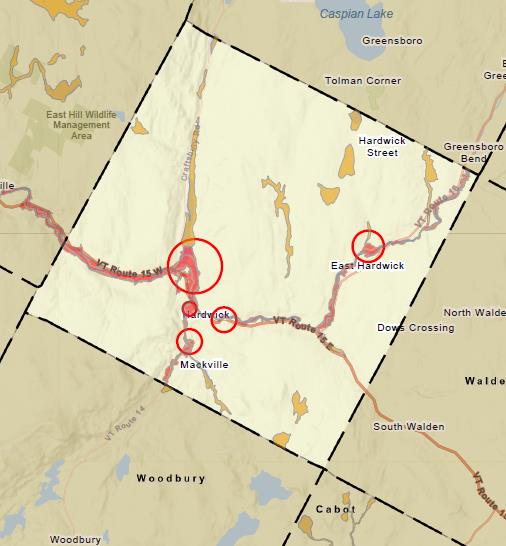
*EDA grant for Flood Models of the Lamoille River and the Cooper Brook. SLR International Incorporated recently concluded the modeling work and is finishing the analysis. Two presentations on the Lamoille River were held on December 3, 2025. A presentation on the Cooper Brook was held on June 10, 2026
*The Hardwick Plan – 2026 has been adopted and includes a Volunteer Amendment with four local categories: Emergency Volunteer Mobilization, Emergency Communications, Emergency Shelter, and the Supply and Support Center. This local management plan provides guidance to each component of the community, including businesses, farms, and residences.
*Hardwick Neighbor to Neighbor Supply and Support Center is a sustainable and ready-to-go element of emergency response.
*The Town Flood Resilience Website pages at Hardwickvt.gov have been updated and have more information for the public.
*The Hardwick Unified Development Bylaws were updated in September 2024 and the Flood Hazard Area Overlay rules now match the requirements from the State of Vermont and FEMA and will be ready for the anticipated update to the Floodplain maps.
*The Hardwick Unified Development Bylaws were updated in 2026 with the addition of a River Corridor Overlay to further improve hazard mitigation funding matches and advance conversation around erosion-impacted properties.
*Six bridges have engineering under way for permanent replacements/upgrades.
*Eleven damaged roads will have updated culverts by the end of 2026. Additional mitigation projects are ongoing on all roads in town.
*The expanded Emergency Alert notification system (TextMyGov) and VT Alert system have been implemented.
*High-water Mark Documentation Project documenting July 2023, December 2023, and July 2024 flood elevations across multiple neighborhoods to support public education, engineering calibration, and future mitigation design.
*Atkins Neighborhood Conversation Series (Summer 2026) focuses on floodplain processes, insurance, mitigation options, and household-scale resilience strategies.
*Emergency Volunteer Training Series (Winter-Spring 2026) aligned with the Volunteer Amendment to the Hardwick Plan, including communications, supply center operations, and neighborhood-based response roles.
*Neighborhood-Based Resilience Coordination piloted through Granite Street Neighbors and extended to other impacted areas to strengthen communication, preparedness, and recovery capacity.
*Historic Flood Documentation and Archival Coordination has occurred in partnership with the Hardwick Historical Society to support public understanding of long-term flood patterns and risk.
*Coordinated sequencing of buyouts, infrastructure upgrades, and floodplain restoration has been designed to avoid isolated investments and maximize cumulative risk reduction.
*Lamoille River Watershed Forum in September will feature presentations on Landslides, Wetlands, and Sediment. An additional presentation is scheduled for August 26 with Jud Kratzer – Strategic Wood Addition.
*Former Buyout Property Planning and Stewardship Framework acknowledged by the Select Board as the Town’s guiding approach for evaluating, maintaining, planning, and seeking funding for former buyout properties.
Neighborhood priorities are sequenced based on flood impact severity, readiness of property owners, availability of matching funds, and the Town’s capacity to advance projects responsibly and effectively.
FLOOD AREA SPECIFIC INITIATIVES
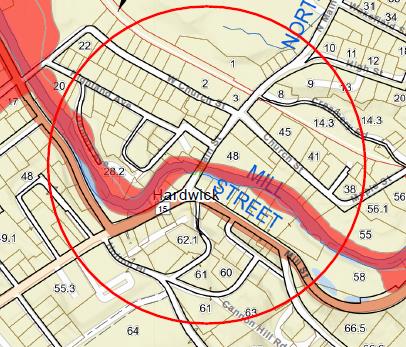
Downtown Hardwick (Lamoille River) *Hardwick Downtown Partnership
Flood Resiliency Projects in Process:
- Mill Street restoration project (Climate Safe Communities Grant written/BRIC)
- EWP 2024 – 2 slope stabilization projects in the engineering phase
- Scoping study for the Downtown section CBDG-DR funding received, Stone Environmental hired and work has begun in June 2026.
- 3 Buyouts – 1 finished and demolished. 1 closed in December 2025.
- Restoration of the Retaining wall next to the Village Diner (FEMA) – in process with the pedestrian bridge installation – June 2026
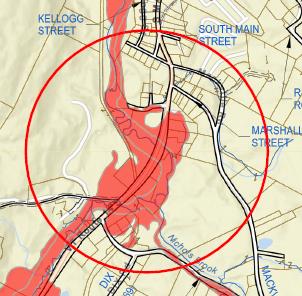
Vermont Route 14 South (Cooper Brook) *No formal neighborhood organization currently identified
Flood Resiliency Projects in Process:
- 2 buyouts – both finished and demolished
- Restoration project – funding identification in process with the Caledonia County NRCD. Community engagement to follow.
- 1 EWP 2024 – in the engineering phase
- 2 Lift stations for WWTF (FEMA) will be upgraded
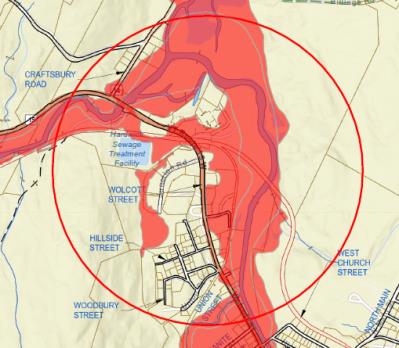
Wolcott Street Commercial (Lamoille River) *Hardwick Business Community
Flood Resiliency Projects in Process:
- Wastewater Treatment Facility Plant upgrades or restoration (FEMA)
- Jackson Dam Feasibility Study concluded. Next steps include public engagement and 30% engineering. Identified as reducing flood risk in both Wolcott Street Commercial and Granite Street District.
- 6 buyouts (Sawmill Park – Future concept) – 3 purchased and demolished. Identified as reducing flood risk in both Wolcott Street Commercial and Granite Street District
- LVRT Embankment issue identified (EDA). Identified as reducing flood risk in both Wolcott Street Commercial and Granite Street District.
- Lamoille River Confluence Floodplain Restoration. CDBG-DR funds received for implementation and engineering. SLR International hired. Anticipated construction in 2027. Identified as reducing flood risk in both Wolcott Street Commercial and Granite Street District.
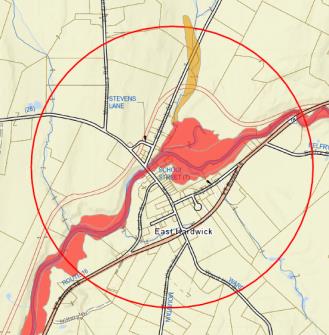
East Hardwick (Lamoille River) *East Hardwick Neighborhood Organization
Flood Resiliency Projects in Process:
- Better Connections Stormwater Overview
- 2 FRCF buyouts closed in April 2026. RFP for Demolition in process. National Park Service technical assistance requested for after demolition.
- 1 Historic property stabilized with EWP 2023 (completed)
- 1 FRCF buyout (completed) in 2024 on School Street
- School Street stabilization (FEMA) – Engineering in process
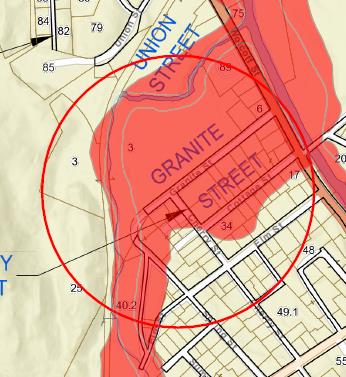
Granite Street Historic District (Cooper Brook and Lamoille River) *Granite Street Neighbors & The Center for an Agricultural Economy
Flood Resiliency Projects in Process:
- Municipal Planning Grant in process – flood mitigation and flood resiliency planning with SLR Consulting. First overview provided to the neighborhood on June 10.
- Additional projects to follow
- Fire Station removal from the Floodplain (FEMA)
- Future mitigation project at the Fire Station site
- Utility Elevation funds received – CRDMF
- High-Water Mark Project in final stages. Concepts being voted on.
- Atkins Neighborhood Conversations (Summer 2026)
- Cooper Brook Cleanup on May 1 – tires, tires, tires.
Lessons learned in each neighborhood are intentionally carried forward to inform work in other areas, allowing the Town to adapt its approach over time rather than repeating one-size-fits-all solutions.
Together, these town-wide and neighborhood-specific efforts reflect Hardwick’s commitment to pairing technical mitigation with community-based resilience, ensuring that recovery investments strengthen both physical systems and social capacity.
Hardwick Buyout Information
Former Buyout Property Planning and Stewardship Framework – June 2026
Hardwick Floodplain Acquisition List – May 2026
Buyout Myths versus Facts – December 2025
The Story of a Flood Buyout in Hardwick – November 2025
VT Digger article on the Civic Standard’s building and possible floodplain acquisition
Granite Street Historic District – Municipal Planning Grant and Flood Resiliency Planning
Granite Street Neighbors – Winter 2026 Update
Granite Street Historic District Utility Elevation Assistance Project – Overview
Granite Street Historic District Utility Elevation Assistance Project – Intake Form
Overview on the project from the State Climate Office: https://climatechange.vermont.gov/centering-community-flood-emergency-management
DRAFT – Flood Resilience Plan from SLR – June 2026
Flood Mitigation Projects in Hardwick
Hardwick Recovery and Resilience Portfolio – June 2026
Hardwick and the Five Neighborhoods of Flood Impact (2023 to 2026) – updated 6-1-26
Overview of Hardwick Resilience Approach – created for the State Climate Action team
Understanding Flood Storage and Floodplain Restoration (2025)
Hardwick Future Flood Resiliency and Mitigation Projects – March 2025
Hardwick Flood Resiliency Projects – 2023 and 2024 (Town Report Version) – January 2025
Hardwick Projects from 2023 and 2024 – October 30, 2024
Hardwick Projects from 2023 and 2024 – August 13, 2024
Hardwick Projects from 2023 and 2024 – August 1, 2024
Hardwick Projects from 2023 and 2024 – July 26, 2024
Adaptation for All: How to Build Flood Resilience for Communities of Every Size (American Flood Coalition – pdf) – page 36 has the Dog River Park in Northfield, Vermont. Stay tuned for a local version!!
Flood Recovery and Resilience Updates – provided to the Select Board in 2025
Flood Recovery and Resilience Update (SB) – 4/17/25
Flood Recovery and Resilience Update (SB) – 6/26/25
Flood Recovery and Resilience Update (SB) – 8/7/25
Flood Recovery and Resilience Update (SB) – 10/31/25
Flood Recovery and Resilience Update (SB) – 12/18/25
Flood Recovery and Resilience Update (SB) – 5/04/26
HELPFUL LINKS
Neighbor to Neighbor – Hardwick Area Neighbor to Neighbor – Need anything? Want to help? Get in touch. Call or text 802-441-3301 or hardwickneighbors@gmail.com
New England 511 – State Road closures and construction information
Vermont.gov/flood – Vermont Flood Resources
The Hardwick Plan – 2025 (our Local Emergency Management Plan with a Flood Annex)
The Volunteer Addendum to the Hardwick Plan – 2025
Tips for Flood Safety During National Preparedness Month – September 2026
By Alison Spasyk, Flood Resilience Educator, Lake Champlain Sea Grant
September marks the start of many things – back to school, the changing of leaves, and the promise of cooler days. September is also National Preparedness Month. Although emergencies and natural disasters can happen at any time of year, now is as good a time as any to think about how well you are prepared for the unexpected.
In the Lake Champlain basin, flooding is the most common and costly natural hazard. As extreme precipitation events become more common, there are some basic steps you can take to be better prepared for future flooding. See below for tips on flood preparedness.
Where to get emergency alerts and flood information
- VT-ALERT is a mass notification services that allow you to receive alerts on your phone and email about situations such as severe weather, unexpected road closures, missing persons, or evacuations. Notifications can be tailored to specific locations and types of alerts you would like to receive. Sign up for VT-ALERT by visiting the website.
- The National Weather Service (weather.gov) issues weather alerts and weather forecasts. Search for your town to get the latest forecast.
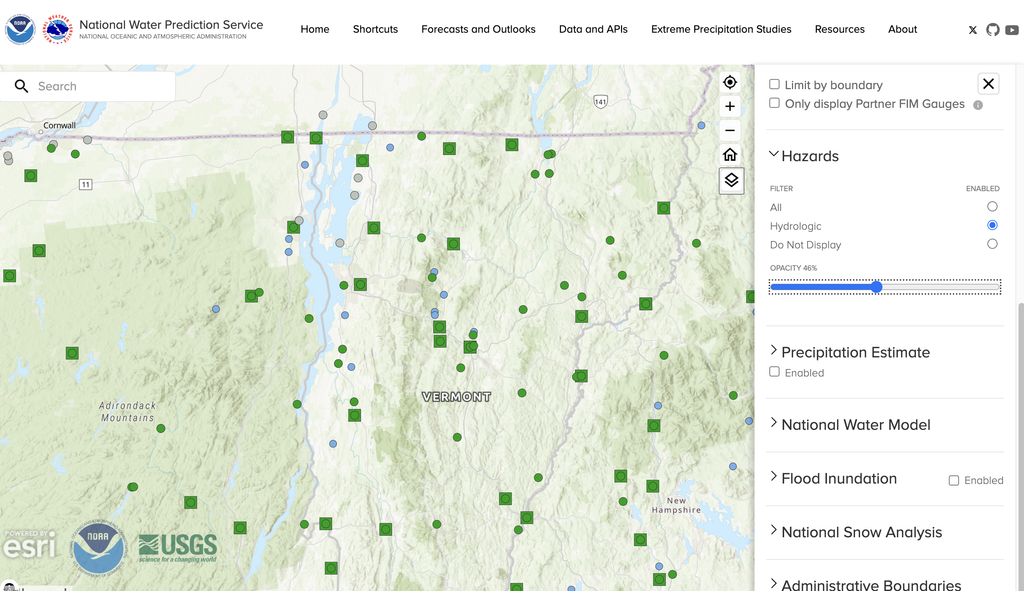
- The United States has a network of river gauges that provide information on current and forecasted water levels, which can be found at https://water.noaa.gov/. The circles and squares represent locations where there is an official NWS gauge. The color of the circle represents current conditions, and the color of the squares represents the water level forecast. If you live along or near a river, check whether there is a river gauge near you. Click on the circle or square to view the current water level, and if available, forecasted water level and flood impacts at a given level.
- If there is a storm forecasted, pay attention to local news stations on TV and radio, and heed instructions about when to take action.
- In the event of a power outage or when internet is not available, a battery-powered or hand-crank radio with NOAA weather tone alerts can provide information about life-threatening weather 24 hours a day, 7 days a week. Weather radios can be purchased at most hardware stores and come in battery-operated and hand-crank models for use during power outages.
Make a plan for flooding for your household
Think about the following questions with your family and household needs:
- What belongings will you move to a higher floor if flooding is imminent?
- If you are told to evacuate, where will you go? Can you stay with someone you know? What about any pets?
- Where are emergency shelters in your community?
- Do you know the best roads to take that likely won’t be affected by flooding or washouts?
- What will you bring? Do you have a Go-Bag (an easily movable bag with the items you need for a few days away from home)?
- Do you know how to safely turn off your utilities in advance of a storm (electricity, gas, and water)?
If a flood is forecasted in your area:
- Move important items to upper floors or high shelves.
- Keep your cell phone charged.
- Bring outdoor equipment inside (trash cans, lawn furniture, toys, hanging planters, grills, etc.) or tie them down securely.
- Fill bathtubs, sinks, and jugs with clean water. This water can be used for drinking, washing, and cleaning the toilet.
- Gather your emergency supplies and stay tuned to local radio or television stations for updates.
- Before a storm arrives, fill up your gas tank or fully charge your electric vehicle to prepare for potential evacuation.
- If possible, relocate vehicles to higher ground.
Lake Champlain Sea Grant will be sharing other helpful tips throughout the month of September on our Instagram. Learn more about flood preparedness and community resilience on our webpage.